Current Systems / Provenance across products, claims and machines
Homebridge Knowledge Observatory
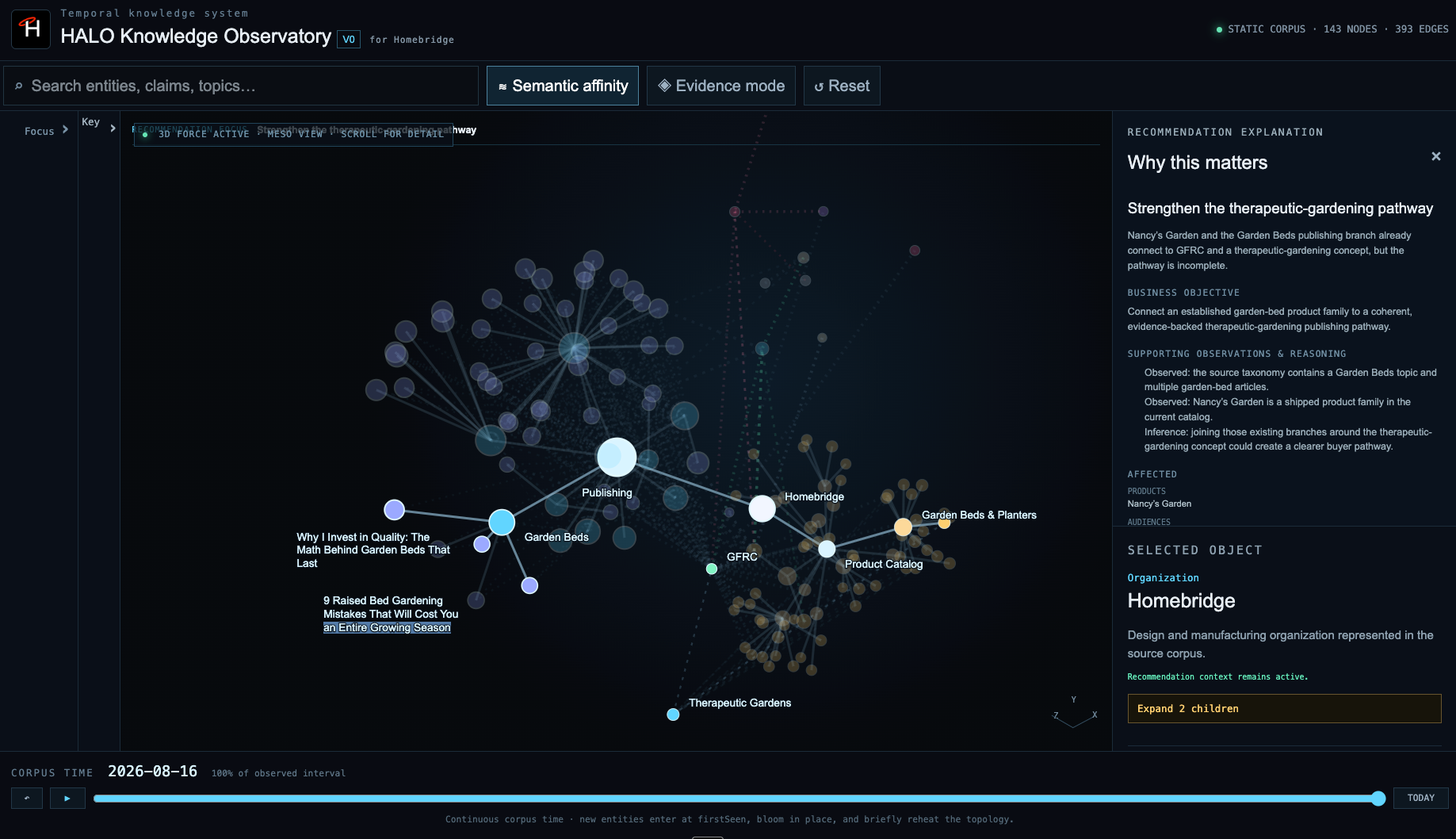
The topology makes publishing weaknesses visible—and measurable over time.
What was supposed to become true?
Create an authoritative knowledge layer that people and external AI systems can discover, inspect and use without losing provenance.
The conditions
The Observatory maps entities, claims, evidence and publishing relationships into a living knowledge structure. Thin pathways and missing connections expose where the corpus is weak; changes in the graph show how that structure develops as publishing improves.
The same structure determines what can be exposed to machines. Instead of treating every document as an undifferentiated source, the system can surface selected, evidence-backed portions of the graph to LLMs and other interfaces.
Discoverability became an information-architecture and governance problem. Every useful assertion needed an entity, a source, an owner, a publication surface and a way to observe what happened after release.
What had to exist
The Knowledge Observatory connects products, entities, claims, evidence, authorship, publishing and external observation as a living topology. AI surfaces extend that authoritative knowledge into conversations and interfaces elsewhere.
- 01
Model entities and names consistently across systems.
- 02
Attach claims to evidence and publication boundaries.
- 03
Project authoritative product knowledge into human- and machine-readable surfaces.
- 04
Observe how external systems describe the organization.
- 05
Turn discrepancies, omissions and stale relationships into explicit editorial work.
David’s role
David conceived the Observatory and its AI surfaces as an operating layer joining information architecture, semantic discovery, publishing, knowledge governance and market observation.
What changed